Straight. True. Always answered.
O Prumo Digital gives your business an AI voice receptionist, WhatsApp automation, a modern website, and a simple CRM — all set up and managed for you, in Portuguese, English, and Spanish.
Everything Your Business Needs to Grow
Five tools, one partner — enterprise-grade digital infrastructure built and managed for Brazilian-owned small businesses.
Never miss another call. Our AI answers every inbound call 24/7, in English, Portuguese, and Spanish — taking messages, booking appointments, and qualifying leads.
Meet your customers where they already are. Automated flows handle follow-ups, appointment reminders, and lead nurturing — without you lifting a finger.
Stop losing leads to sticky notes and spreadsheets. A complete CRM tracks every contact, automates follow-ups, and shows exactly where your business stands.
A website that works as hard as you do. Mobile-first, multilingual, and built to convert visitors into booked customers — with forms and local SEO built in.
Get found first on Google Maps. We optimize your Google Business Profile and automate review requests so customers choose you with confidence.
One System, Running Your Whole Business
From the first missed call to the five-star review — here's what happens behind the scenes.
When a call comes in after hours or while you're on a job, the AI receptionist picks up or texts back on WhatsApp within seconds, in the customer's language.
- Missed-call text-back in under 30 seconds
- Qualifies the lead and books the appointment
- Hands off to you the moment it gets tricky
Every lead lands in one visual pipeline — from first contact to job complete — so you always know what's next and who to follow up with.
- One pipeline for calls, WhatsApp, web & forms
- Automated reminders keep deals moving
- See your whole business at a glance
Every completed job triggers a review request — built the compliant way, so happy customers go public and any concern comes straight to you first.
- Automated Google review requests
- Private feedback route for concerns
- Higher visibility on Google Maps

A prumo hangs perfectly straight, cuts through uncertainty, and shows exactly where true vertical is. No guessing. No drift. Just precision.
Built for the Brazilian Business Owner
O Prumo Digital exists to help Brazilian and Latin American immigrant small business owners become the entrepreneurs they came here to be. We give the one-man contractor, the overlooked salon owner, the family-run landscaping crew, the front office they never had — an AI-powered voice and messaging system that answers every call, speaks their customer's language, and never lets a lead slip away.
Named after the plumb line, an ancient tool for building straight and true, Prumo is built on faith, integrity, excellence, and relationship.
We are not selling software. We are helping someone go from surviving to leading — from answering their own phone at all hours, to running a business with dignity and professionalism, and getting back the time with family that they deserve.
Simple Start, Powerful Results
From first conversation to a fully automated business — in four clear steps.
Simple, Transparent Plans
Pick the level of automation your business needs today — upgrade anytime as you grow.
Join early and lock in founding-member pricing while we build your automation from the ground up together — with the same hands-on attention as our very first clients.
Ready to be found, booked, and remembered?
Fill out the form below and let's figure out exactly how automation can grow your business.
Let's Talk About Your Business
Whether you speak English, Portuguese, or Spanish — we're here to help. Tell us about your business in the form below and we'll follow up personally.

Reduce Missed Calls: Boost Your Business Revenue
Small Business, Customer Experience, Automation
The Invisible Cost of Missed Calls: How Much Money Is Dropping Through the Cracks?
For local service businesses, the phone is still the front door. Yet in 2026, thousands of dollars quietly disappear every month because calls ring out, go to voicemail, or get returned too late. The good news: with the right mix of rapid response and smart automation, those leaks are fixable—and the ROI can be dramatic.
The Hidden Impact of Unanswered Calls in Local Service Sectors
Across U.S. small businesses, an estimated 62% of inbound calls are missed, and about 85% of callers who reach voicemail simply hang up instead of leaving a message (RingReady, 2026). That means most “we’ll call you back” opportunities never actually exist—because the caller has already moved on to a competitor.
For a typical small service business, each missed call is worth roughly $1,200 in potential revenue, adding up to about $126,000 per year in lost income (RingReady, 2026). That is effectively an extra full-time salary vanishing through the cracks—without showing up on any line item in your P&L.
The stakes climb even higher in local, high-value sectors:
Home services (HVAC, plumbing, roofing): 27–38% of calls are missed, with an average revenue loss of about $78,400 per year per contractor (Clockwork, 2026).
Medical and dental practices: a missed new-patient call can cost $240–$750, with annual losses commonly in the hundreds of thousands (VoiceboxMD, 2026; BuzzWisely, 2026).
Law firms and real estate: one missed intake or buyer call can be worth $3,200–$12,000+, with mid-sized firms and teams losing tens of thousands every month (RingReady; BuzzWisely, 2026).
📌 Key Takeaway: Missed calls are not a minor nuisance; they are a recurring, six-figure revenue leak for many local service businesses.
Why Rapid Response Times Matter More Than Ever
In local services, customers are often in “need it now” mode: a leaking pipe, a broken AC, tooth pain, a last-minute salon appointment, or an urgent legal question. When their call goes unanswered—or is returned hours later—they rarely wait. They simply dial the next business on Google.
Industry data shows that speed to first response is one of the strongest predictors of whether a lead converts. Even a delay of 15–30 minutes can slash your chances of winning the job, especially in competitive markets where multiple providers are just a tap away. In other words, it’s not enough to eventually respond—you have to respond fast.
The Real-World Consequences of Slow or Missed Responses
The obvious consequence of a missed call is lost revenue. But the ripple effects go further:
Damaged reputation: Customers equate unanswered phones with poor service. Over time, this fuels negative reviews and word-of-mouth that quietly depresses demand.
Lower client lifetime value: When new patients, homeowners, or buyers never connect with you in the first place, you also lose years of repeat business and referrals.
Operational blind spots: Missed calls are also missed data. You lose insight into peak demand times, common questions, and service gaps that could guide smarter staffing and marketing.
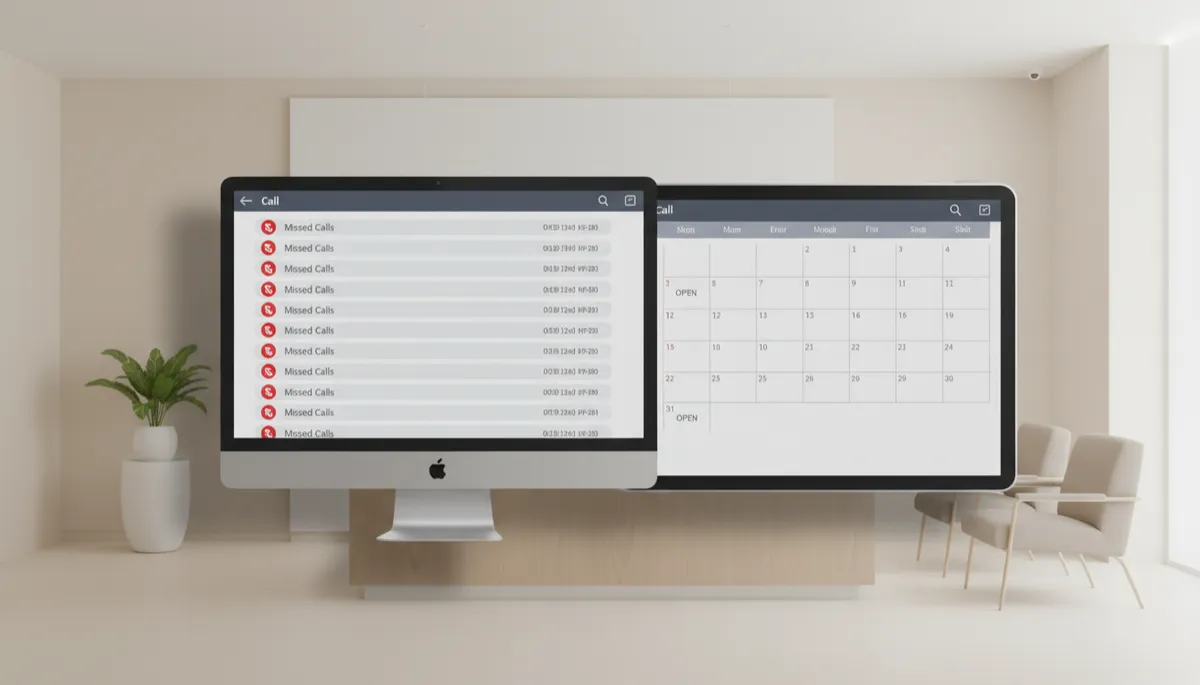
Persistent missed calls quietly translate into empty calendars and predictable revenue shortfalls.
What the 2026 Benchmarks Tell Us About Revenue at Risk
Cross-industry benchmarks from 2026 paint a stark picture of how much money is at stake for local providers (BuzzWisely, 2026; 24hrReceptionist, 2026):
Real estate: about $12,000 per missed buyer lead; teams can lose $24,000–$48,000 every month.
Law firms: $3,200–$10,000+ per missed intake call, with mid-sized firms dropping around $12,800 per month in opportunities.
HVAC & plumbing (emergency): $850–$1,100 per missed call, and HVAC contractors alone can see $13,206 per month in lost bookings.
General contractors: with jobs averaging $14,500, monthly missed-call losses can reach an eye-watering $182,700.
Even at the lower end—salons and spas, where a missed call averages around $95—businesses still forfeit roughly $5,000 or more per month in potential revenue. The pattern is consistent: whatever your sector, missed calls are one of your biggest invisible expenses.
How Automation Can Catch Calls and Prevent Revenue Loss
The challenge for local businesses is simple: you can’t afford to staff a full call center, but you also can’t afford to miss calls. Modern automation bridges that gap by ensuring every inbound call is acknowledged, routed, and followed up—without adding headcount.
AI receptionists and intelligent IVR: Agentic AI can verify identities, capture reason for call, book or reschedule appointments, and send confirmations automatically (JustCall, 2026). In many environments, these systems can fully handle 40–60% of routine calls, freeing humans for complex cases.
Smart callback workflows: If all lines are busy, automation can instantly text the caller, confirm their need, and queue a priority callback—preserving the lead instead of letting it drop to voicemail.
Agent-assist tools: For calls that do reach a person, real-time prompts, knowledge suggestions, and automated note-taking cut handle time and allow teams to answer more calls without burning out (Zoom, 2026).
💡 Pro Tip: The most effective 2026 strategies don’t replace humans—they use automation to handle predictable tasks and make sure your team only deals with high-value conversations.
Practical Strategies to Plug Revenue Leaks with Automated Solutions
Turning missed calls into booked business doesn’t require a massive transformation. It requires a focused, layered approach to automation that fits local-service realities. Consider these strategies:
Start with 24/7 call capture. Implement an AI or virtual receptionist that answers after a set ring threshold or outside business hours, gathers key details, and offers to schedule or request a callback. This alone can recapture a large share of after-hours and overflow calls.
Automate appointment booking and reminders. Connect your phone system to an online calendar so callers can self-book or confirm appointments via voice or SMS. Automated reminders reduce no-shows and make every recovered call more profitable.
Use analytics to fix staffing gaps. Conversation analytics and call reports reveal peak times and common call types (CX Foundation, 2026). You can then combine smarter scheduling with automation to ensure coverage when it matters most.
Layer in proactive follow-up. For missed or abandoned calls, trigger automatic texts or emails within minutes: “Sorry we missed you—reply here to book a time.” This quick touchpoint preserves trust and keeps you in the running for the job.
Measure the ROI relentlessly. Track how many calls are answered, how many appointments are booked, and how much revenue is tied to recovered calls. Because each call is often worth hundreds or thousands of dollars, even modest improvements typically pay for the automation many times over.
From Leaky Funnel to Revenue Engine
Missed calls are one of the most pervasive—and most fixable—sources of lost revenue in local service sectors. Benchmarks from 2026 show that what looks like a few unanswered calls a day often adds up to six or even seven figures a year, especially in high-ticket fields like law, real estate, healthcare, and home services.
By prioritizing rapid response times and deploying automation thoughtfully, you can transform the phone from a leaky funnel into a reliable revenue engine—one that captures more opportunities, delights more customers, and supports sustainable growth without overwhelming your team.
